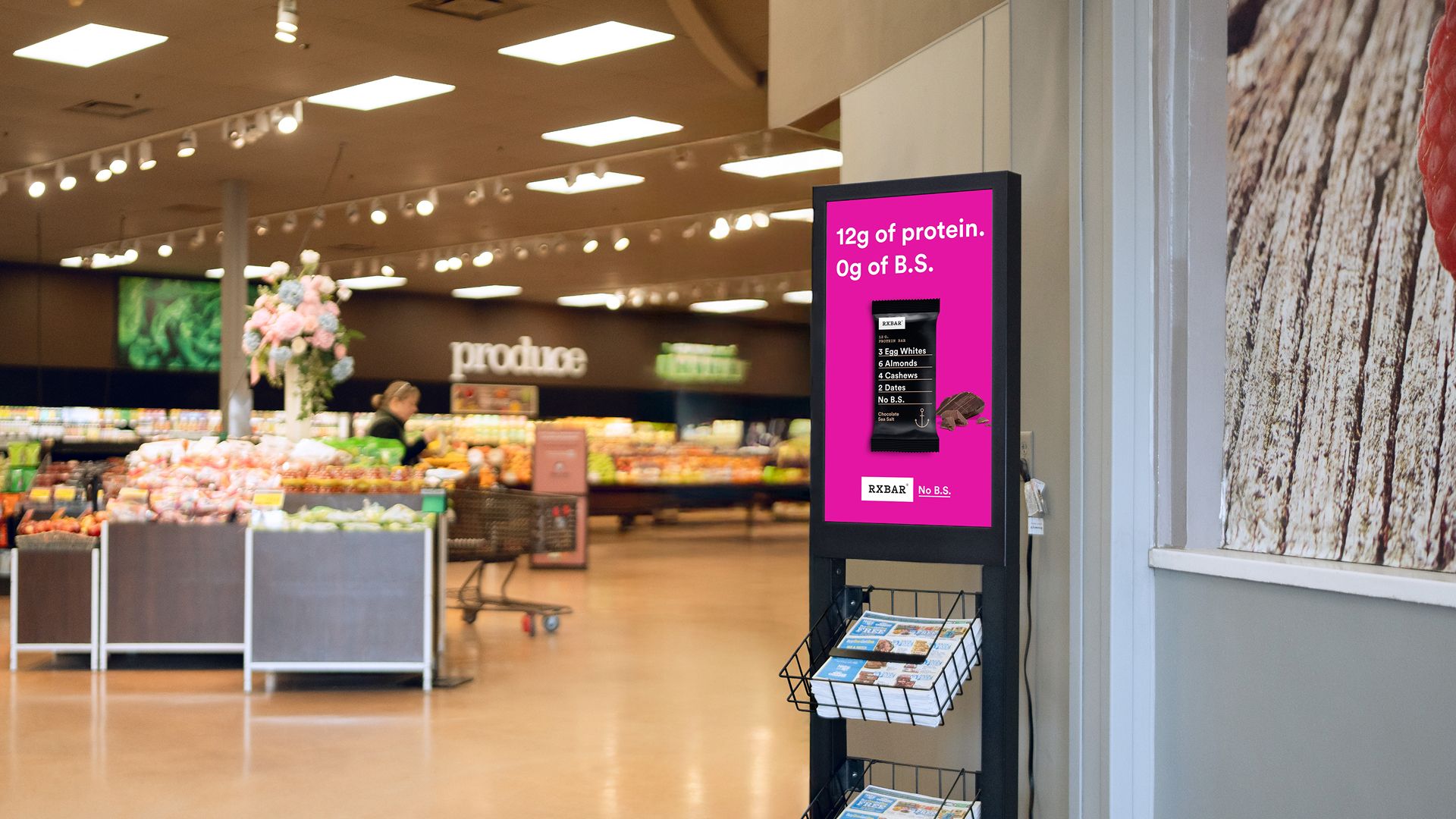

Financial services marketers have spent years getting better at targeting consumers. Solutions like behavioral signals, intent data, lookalike audiences, predictive modeling are better than they have ever been. Yet most campaigns still struggle with the same fundamental problem: reaching people at the moment they're actually thinking about money.
One of the biggest challenges with relying too heavily on intent signals is that they are inherently backward-looking. By the time a behavioral profile marks someone as "in-market" for a credit card, a personal loan, or a mortgage product, the window may have already closed. The contextual relevance of reaching consumers in an environment where the message fits the moment is a different kind of match, and one that digital channels rarely deliver.
There's a channel that gets financial services brands closer to that moment than most, and it’s not a new platform or an emerging format. It's the grocery store.
The store is already a financial environment
Grocery shopping is a financial exercise, and, for most households, groceries represent the single largest recurring weekly expense. According to the USDA, the average cost of food at home for a family of four can reach $300 per week. That makes the grocery run something most financial services brands overlook: a high-stakes spending moment that happens every week, on a predictable schedule.
The person shopping in the store is also often the household financial decision-maker. They compare prices, weigh trade-offs, and decide in real time what's worth paying for. New research makes this concrete: 82% of grocery shoppers say they are careful with their money, 78% compare prices online before buying, and 82% know their credit score. This audience is financially literate, budget-conscious, and already primed to think about value.
For financial services brands, that context is hard to manufacture anywhere else. When a credit card ad reaches someone who is, at that moment, choosing between store brands or calculating what's left in the week's budget, the message lands differently than it does on a social feed or a streaming platform. You're speaking to them when they’re in a financial mindset.
The reach problem digital channels can't solve
Even for brands that have built sophisticated digital targeting programs, there's a ceiling to how many customers they can reach. In-store retail media reaches a meaningful share of audiences that aren't captured by display, streaming, or linear TV. The store drives 49% more incremental reach on top of existing campaigns, and it doesn't require bidding against the same crowded programmatic inventory.
The frequency math also works differently. Grocery is one of the few remaining high-frequency media touchpoints. Consumers return weekly, creating consistent exposure over time without the escalating CPMs that come with digital saturation. For financial services brands trying to build awareness and consideration among a specific audience, that combination of frequency and context is difficult to replicate elsewhere.
The behavioral profile of a grocery audience also skews toward exactly the consumers financial services brands are trying to reach. Research shows that 77% of grocery shoppers research financial services before making a decision, suggesting an audience that actively engages with financial advertising.
Where in-store fits in the marketing plan
The most common question financial services marketers ask about in-store media is where it belongs in the funnel. The honest answer is that it depends on the objective, but the channel has demonstrated performance across multiple stages.
For brand awareness and consideration, the contextual environment and consistent frequency make in-store a natural fit.
For acquisition-focused campaigns, the timing matters, and the intent signal is more direct than most marketers realize. Every time a shopper reaches the checkout, they're making an active decision about which card to pull out of their wallet. That moment is one of the most valuable touch points available to a financial services brand, and one that no digital channel can reproduce.
Measurement in physical retail environments is different from digital attribution, and brands that apply the right measurement framework typically see strong results. Matched-market analysis and third-party lift studies are the standard for in-store, providing reliable campaign-level ROI data. Brands that approach in-store with the same attribution expectations they bring to display advertising will be frustrated.
What forward-looking financial services brands are doing
A growing number of financial services brands are beginning to treat in-store retail media as a consistent part of their awareness strategy. What separates the brands that have gotten traction from those still in pilot mode tends to come down to three things.
First, they've matched their objective to the channel. In-store is particularly effective for building awareness among financially engaged consumers and for reaching specific in-market segments at moments of heightened relevance, from mortgage to credit card acquisition and tax-season products. Brands that have tried to force last-click attribution models onto in-store campaigns have largely come away disappointed.
Second, they've invested in contextually relevant creative. An ad for a rewards credit card that appears in a grocery environment, where consumers are actively thinking about how to stretch their budget, benefits from that context. But the creative has to meet the moment: generic brand advertising doesn't take advantage of the environment the way message-specific, benefit-led creative does.
Third, they've built frequency. The grocery visit is a weekly habit, and that environment rewards consistency. Brands that show up regularly over time, rather than running a short flight and measuring lift after only a few weeks, see compounding awareness gains.
The case for getting in early
In-store retail media is still in a relatively early stage of adoption for non-endemic advertisers, including financial services. That's both a challenge and an opportunity.
The challenge is that internal stakeholders need to be educated on a channel that doesn't map cleanly onto existing digital frameworks. The opportunity is that early movers benefit from strong inventory availability, lower competition, and the ability to establish creative and measurement best practices before the channel becomes crowded.
The brands that waited on CTV, social video, and digital audio and then scrambled to catch up as costs rose and attention fragmented will recognize the pattern. In-store is at a similar inflection point. The audience is captive. The measurement infrastructure exists. The scale is meaningful. The question is whether financial services marketers are willing to treat context as a targeting parameter rather than an afterthought.
The grocery store already has the audience financial services brands want to reach. The consumers are financially engaged, high-frequency, and already in a decision-making mindset. Getting in front of them there is less complicated than most marketers assume, and more effective than most digital alternatives can deliver.